Case file № 006 · Trust design · Verification
A raffle nobody has to take on faith
- System
- FairDraw
- Client
- Public tool, self-directed
- Live
- fairdraw.xyz ↗
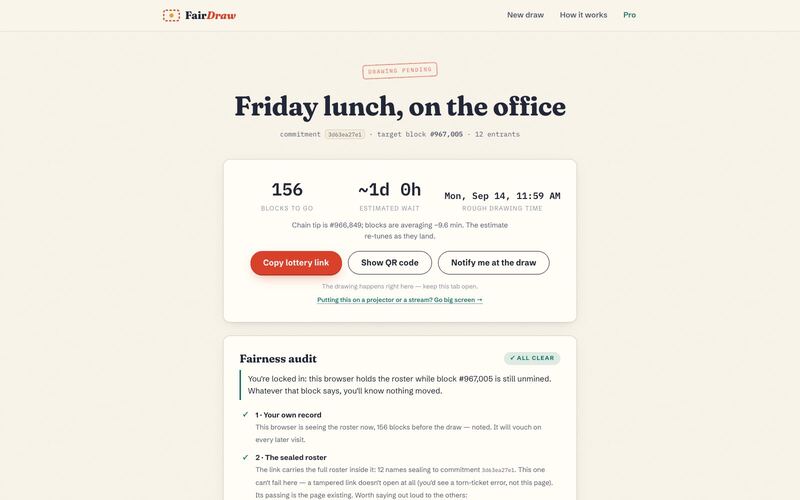
An online giveaway asks every entrant to trust the host, and an honest host has no way to prove anything. FairDraw seals the entrant list into a link, lets a future Bitcoin block pick the winner, and hands anyone three lines of Python to check the result.
 Live
LiveThe evidence
Screens of the running thing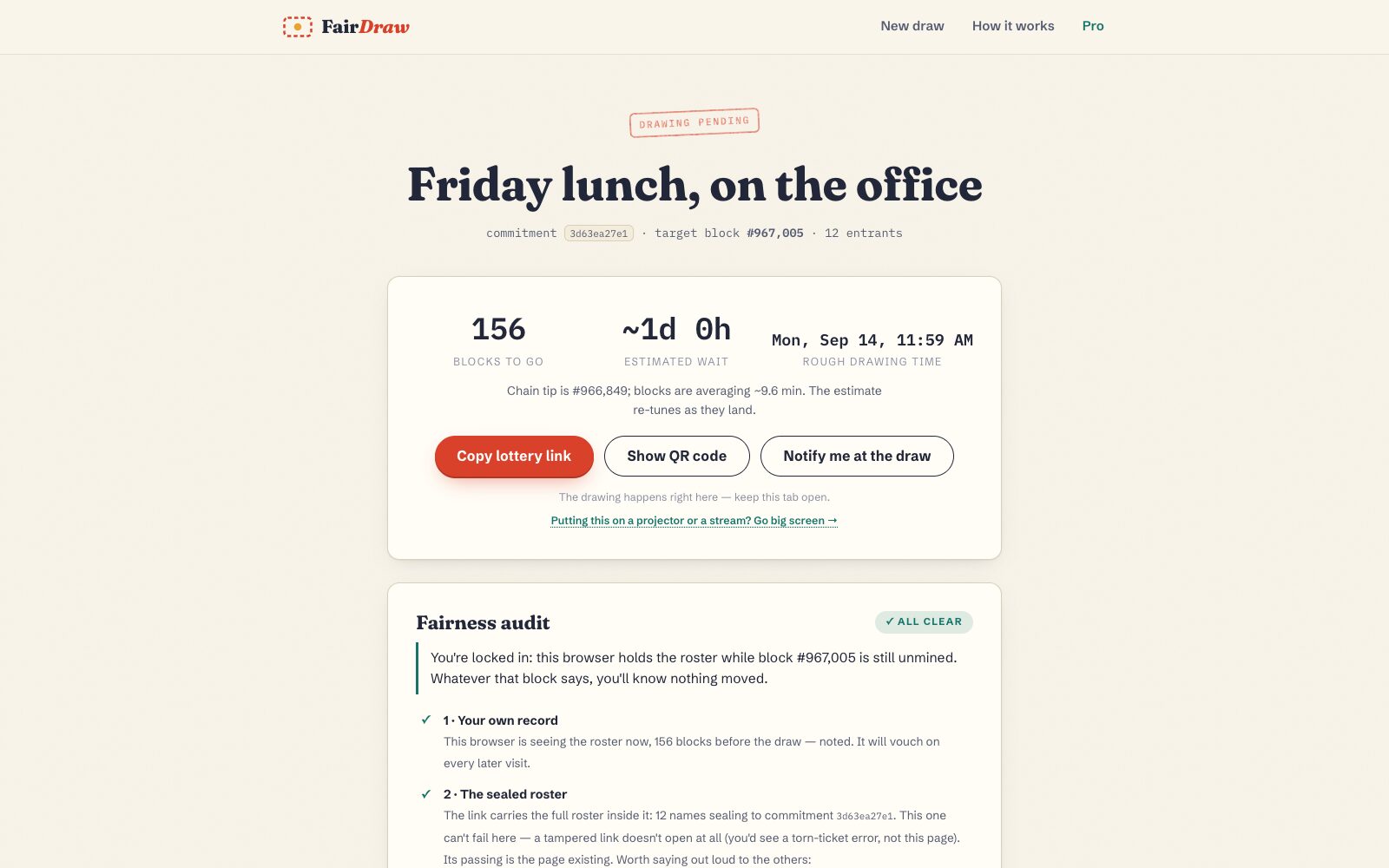
The system
How the parts connectIn
Entrant list pasted, or imported from a thread
Target block height chosen in the future
The system
Sealed link roster + commitment + timestamp proof
Bitcoin block hash two sources that must agree
Out
Ranked result exactly equal odds · runners-up free
Graded certificate proven · witnessed · unproven · failed
Before & after
The account, both columnsBefore
- The host of a giveaway says “I used a random number generator.” The entrants take their word for it, or don’t.
- Even a scrupulous host can’t prove the list wasn’t edited after entries closed, or that the draw wasn’t re-run until a friend came up.
- Any tool that fixes this by running its own server has only moved the trust: now you are trusting the tool.
After
- The roster, the prize, and a target block height are compressed into the link itself. Its fingerprint is the commitment; sharing the link freezes the list. There is no server to trust because there is no server.
- When the target block is mined, its hash is read from two independent sources that must agree, and the draw waits for one more block on top before calling itself confirmed. A chain reorganization replays the draw and says so.
- Each entrant’s score is a hash of their name and the block. Sorting those scores is a fair shuffle, so runner-up places come free and every entrant’s odds are exactly equal. The test suite runs the three-line Python verifier against the app’s own code and fails the build if they ever disagree.
- To prove the list existed before the block, the link also carries a timestamp proof from public calendars, in a compact format written for the purpose, and the page verifies it against the chain. A host importing entries from a forum thread can bind the roster to that thread, so anyone can re-derive it from public data.
- Every draw is graded on a certificate: proven, witnessed, unproven, or failed. The bar for saying “rigged” is deliberately high, because a deleted comment looks identical to an invented name, and a false accusation costs a real person their reputation.
The verdict
The claim was never “fraud is impossible.” It is “any rig leaves visible scars,” and the written threat model says exactly which mechanism proves what, to whom, and where each one degrades. That is trust treated as an operations problem: define what is checkable, make checking cheap, and be honest about the rest.
Bill of materials
What was used, and the job it did| 01 | Svelte + TypeScript | the whole app; zero runtime dependencies |
|---|---|---|
| 02 | Bitcoin block hashes | the randomness, read from two APIs |
| 03 | OpenTimestamps | proof the list came first; implemented from scratch |
| 04 | Written threat model | what each mechanism proves, and to whom |
| 05 | Cloudflare Pages | hosting; the page is the only moving part |